Fringegestion
Some fringers have great tolerance and can take in as many shows as possible in one day, while others need more time between events so as to digest what they've seen. Four shows in one day is my maximum, with one or two exhibitions in between. Over that limit and my cultural lobes crash. Normally takes a day or two for the desire to gamble time and energy on more fringely opportunities to revive. But sooner or later, I gambol off to well trodden venues or in search of new (and more comfortable) theatre spaces.
Gazing vacantly at enthusiastic young acts in the High Street helps regain a sense of perspective in the short term.
Anyone familiar with the concept of the fringe will be aware, or at least guess that it is used to set up fringes to some of the other festivals in Edinburgh. So, the Book Festival has a fringe. The one event I managed was Helen Zaltzman and Olly Mann reading from their book Answer Me This? A very popular event and sort of entertaining in it's way.
Then it was time for Jackie Kay at the Book Festival. This was one of the funniest events I've been to this month, if not this year.
Next up, Bumfluff and Brimstone. This is where the fringegestion kicks in, after the glorious wit of Jackie Kay to a woman in her first Fringe show having decided at 40 that she wanted to do stand up. She tried, and some material was quite good, but, my perception of her was coloured by the previous event.
Following a short gap and time for a bit of a walk I finished the day with the reliably funny Kate Smurthwaite. After my last year's rant about her not getting enough TV, she is now making a welcome habit of appearing on comment pieces and discussion programmes and speaking up for rational feminism.
Next day brought a change of focus with the Festival of Politics at Holyrood. As with the Book Fringe, I could only fit in one event. Is the far north safe in Nordic hands? Chaired expertly by Lesley Riddoch with presentations from a Norwegian oil and gas exploration representative, and a woman from Murmansk asserting the ecological viewpoint, this did not disappoint. I knew little of the arguments surrounding this discussion, so I was on a steep learning curve. Pressure to find new oil, gas and fish stocks will mean that the nations surrounding the Arctic are looking at ways to exploit the resources, developing new technologies to do so and generally panicking those who don't trust nations or companies not to wreck the fragile environment in that area.
That had been all I'd planned to do as I'd had lots the day before and anticipated a heavy fringeathon the next day. But, little goes to plan and as I walked up the road, I was invited into a free Burn's show, free three course, Vegetarian Burn's Supper and free ten year old Tallisker whisky.
I'm not going to refuse that. I'd not been in Monteith's restaurant before, but I'll be going again judging by the standard of the food. The vegetable terrine starter was sublime, the veggie haggis was ok and the raspberry Cranachan was scrummy. The show was really good fun, especially as this was the final one and they were more than a little demob happy.
Two good days on the fringe, demonstrating that if you wander about the city opportunities sometimes land in your lap.
Brief reviews
I've not had time or inclination to update the blog on what I have seen and this is reflected in what is a miserly piece on three really good shows that should have more said about them.
Mary Mary Quite Contrary stand up from Mary Bourke, at the free fringe.
Please just take it as read that I have raved on about her. I will spare the repeat from last year where I labour the point that there are some very good women doing stand up in Edinburgh, but the big venues fail to promote them. And I despair of seeing the likes of Mary Bourke on my TV on a Saturday night anytime soon. Rather, it will be the usual continuation of shouty, marchy up and downy blokes all winter when we should be seeing comedy that appeals to a much more intelligent demographic, like feminists!!
Didn't quite avoid repetition of my point about more funny women who do not offend easily offended feminists.
Bosom Buddies with Jack Klaff
A complete change of mood from the above, but enthralling theatre. Thankfully, the audience is given a handout of the characters played in this one hander as there were one or two historical people I'd never heard of. I came home to google Ottoline Morrell, Margarete Buber-Nueman and Sabina Spielrein. I'd heard of all the male characters, as history is meticulous about recording them and making us search for the women portrayed by Jack Klaff.
I'd need to see it at least twice more before I could really convey how this piece of conversations between the characters, spanning major events in the 20th Century ebbed and flowed around and about the Cuban Missile Crisis, psychoanalysis, relativity, African, Indian, Russian history and probably more that eluded me.
Next time this is performed I'll get another ticket.
Booking Dance Festival: Split Bill
This American company brings dance troupes to the Fringe to showcase excerpts from their shows and assists those in the industry to book the acts. They also have tickets for the public.
I'm afraid I have to rave again, this time about three utterly distinct dance performances in one afternoon, starting with Rhythmic Circus. Described as 'Live Music and Rapid Fire Hard Hitting Tap' this was energy squared backed up by a very good seven piece live band. The ultimate in pretty people entertained a moderate sized crowd in Edinburgh's International Conference Centre. I just clapped my little hands off while they tap danced through hip-hop, funk, blues, and soul music.
Next Damagedance performed their world premier of Glimpses. This powerful performance explored psychological disorders, demonstrating that everyone suffers from something to some extent. We try to hide it.
I was initially cautious about this, but after a few minutes I was completely won over by this amazing group of young dancers.
Finally, Labyrinth Dance Theatre performed Noor. I liked this, and the complete change of pace contrasted with the previous two dances. However, it did not move me as much as I expected for a story of the tragic heroism of Noor-un-nisa Inayat Khan. But I was very happy to be reminded of one of the women who played an important part in WW2 and who was awarded the George Cross.
Golden Rules
The installation reminded me that I should be grateful to live in a country which does not have the death penalty even though the behaviour of some (almost always violent male criminals) sometimes seems to deserve it. But also that I live in a country where convicted criminals can be given release on compassionate grounds irrespective of their guilt, in order to spend their last days out of prison/with their family.
Akvani are a trio who sing Georgian songs, in this case ancient healing harmonies to 'sweeten the soul'. It was billed as a 'soundbath of harmony' and certainly lived up to that description.
These songs were originally sung, some as early as pre-Christian times, to appease the Batonebi Spirits and to heal sick children. I'd liked to have heard more about this, and if I can manage it I'll go to another of Akvani's events running this week or next.
In the evening I went to a talk on Women and the Built Environment at Engender. A real circuitous meander round the need for women's input into living space, in particular places like refuges or social housing. And the way that outdoor space is prioritised for male activities for example five aside football instead of dance or yoga or whatever women want. Of course we don't know what women want as no one asks or listens when we speak up anyway. I can claim this from my own experience of taking part in planning consultations where what I or other women say, never makes it into recommendations, or frequently is not even recorded.
The conclusion from this discussion is that we need more women in architecture, planning, engineering and for those professions to actually speak to each other so we get joined up plans. The Golden Rule as applied to planning as well as to politics.
What thou avoidest suffering thyself seek not to impose on others. – Epictetus
Festivalising begins
While I was not moved to great delight by the prints, I liked them and would go again to look in more depth and in less crowded circumstances. I'd also need to return to listen to Vicki Bennett's LP, People Like Us as it was too warm and too busy to do that adequately yesterday.
The LP cover art installation was fascinating. Two opposite walls of LP covers almost none of which I've ever owned, with the trite exception of Led Zepplin IV.
The exhibition describes this installation thus:
...the project recalls the golden age of the record cover in the thick of post-psychedelia's goth-surrealistic art-nouveau apocalyptic landscape explosion...
The art is often viewed for at least as long as the duration of the record - for much longer than most gallery-based work. The record cover synaesthetically maps the sonic journey inscribed on the record.Yeah, that's what I thought about it too. But as I go everywhere with my archetypal radfem head on, I also could not fail to see the explicit torture motif underpinning a sizable minority of the covers on display. The torture was almost without exception of women, women's bodies and where not explicit was merely the banal encouragement of the male gaze so precious in art.
The question posed in Norman Shaw's essay in the exhibition is "Why does the devil have all the good tunes?" (Echoing plaintive cries of 70's evangelical Christians faced with keeping their young folk on the straight and narrow when tempted by good music, but off-message lyrics.)
The radfem question is more likely, "why does such great rock music have to be at the expense of the bodily integrity of women?" But that wasn't answered either at the height of the rock age or now when we are steeped in misogynist music video. The arguments would involve more and better crafted writing than I'm up for today when I want merely to feed back my instant observations on an exhibition that is thoughtful and thought provoking.
In amongst the 'apocalyptic' stuff were curious insertions. LP's by Jimmy Shand, surely the least goth-surrealistic of all musicians, while the Black and White Minstrel cover displayed a long discarded version of unthinking racism to which we are (mostly) no longer exposed. And the Tubular Bells artwork cannot be accused of transgressing any diversity issues.
It's certainly an exhibition to return to and spend more time viewing and thinking about the messages conveyed in the LP covers. It was also an opportunity to wallow briefly in memories from a time where I had to endure my brother's taste in prog rock while fielding his scorn of my enjoyment of glam rock.
Edinburgh Art Festival Programme has more details of the exhibition.
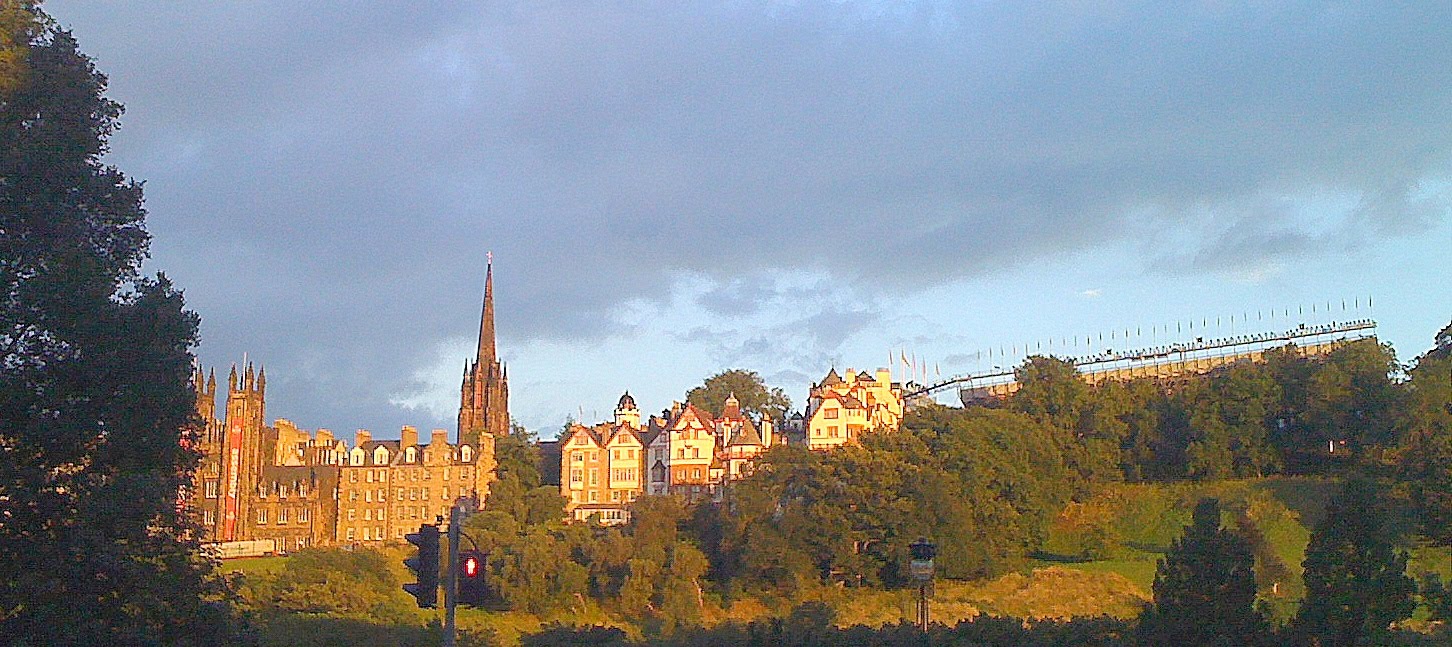
Evening sun shining on the castle esplanade which is built up with seats ready for the annual Military Tattoo which proclaims its triumphal conclusion each night with a volley of fireworks resounding off the tenements in old and new towns. Iirritating!
RIP Radical Feminist Pirate
I was privileged to see her speak on two occasions when she travelled to the UK. Her use of language made her perhaps less accessible than some other feminist academics, but her passion inspired. As did her heroism in standing firm against the college who instead of treasuring her genius sought to stymie her every effort to prioritise women’s education.
The theft of her energies by her college is well documented and this passage demonstrates what feminists mean when they talk about male entitlement. This is it in operation when one egotistical boy pouts, stamps his privileged foot and is facilitated by the male (right wing in this case) establishment to get his own way.
“For thirty-odd years she has hung on by a thread to the academy -- a thread that has now been cut by Boston College, which has suspended her for her long-time policy of teaching only female students in the classroom (and male students in independent study). Whatever one thinks of her policy, the college's tactic is a little too transparently vindictive, as is the role of the Center for Individual Rights (the right-wing backers of the student who brought suit against Daly for discrimination). One does expect, however naïvely, of people who call themselves conservatives that they will have some sense of their own long-term interests. If they had been trying to prove Daly right -- by demonstrating the power of a stripling boy to reduce an old woman to dishonor and poverty with the help of a male-controlled hierarchy -- they could not have chosen a better tactic.”The links at the end of this post give more detail of this disgraceful behaviour by Mary Daly’s employers.
Mary Daly was a feminist theologian. This meant she took her philosophy into the heart of the patriarchy – religion and opened it up to scrutiny using her gift for deconstructing language and uncovering layers of meanings, as this quote shows.
"Ever since childhood, I have been honing my skills for living the life of a Radical Feminist Pirate and cultivating the Courage to Sin," she wrote in the opening of "Sin Big," her New Yorker piece. "The word 'sin' is derived from the Indo-European root 'es-,' meaning 'to be.' When I discovered this etymology, I intuitively understood that for a woman trapped in patriarchy, which is the religion of the entire planet, 'to be' in the fullest sense is 'to sin.' "When asked in one interview about criticism from other feminists she replied:
“Maybe they focus too much on criticizing. You know, it seems to me that if you spend a lot of time criticizing rather than creating, that suggests a lack. I do have critiques of de Beauvoir, there are a lot of ways in which I think she's wrong. And I've written about it, but I don't spend a lot of pages on that; I respect her for what she's done. So I think a lot of that [focus on criticism] is just leaning on me, or on any village guru -- and that's not what I ever want to be -- leaning on me instead of branching out. My intention, say, in writing Gyn/Ecology was to -- truly for it to be a springboard, say for example the Second Passage [Daly's comparative analysis of Indian Suttee, Chinese footbinding, African genital mutilation, European witchburnings, and American gynecology, with an afterword on the influence of Nazi medicine on American gynecological practice]. And instead, You didn't do it perfectly, there's something wrong with what you did about the African genital mutilation, oh go to hell. It's just a springboard! You carry on, when you have specific knowledge.”That answer encapsulates the frustration I feel when I see women sometimes wantonly, ripping into other women’s work. This is the activity of the oppressed not that of (allegedly) empowered equality.
I read Gyn/Ecology The Metaethics of Radical Feminism when I was pregnant and two and a half decades later, I still recall much of it, such is the impact of her writing. It contains a valuable overview of how we got here and reading it, no one male or female can be left untouched by the harm caused to humans by unthinking, belief in the patriarchy. For me, this is the central message of radical feminist thinkers like Mary Daly; patriarchy damages all of us, not just women.
I've not yet read her later books. This is a project I may keep for some future date when I need reinvigorated and reinspired. As Mary said:
“You guard against decay, in general, and stagnation, by moving, by continuing to move.”Mary Daly understood that change is not going to happen overnight and looking ahead to this century she also said;
“Women who are Pirates in a phallocentric society are involved in a complex operation. First, it is necessary to Plunder -- that is, righteously rip off -- gems of knowledge that the patriarchs have stolen from us. Second, we must Smuggle back to other women our Plundered treasures. In order to invert strategies that will be big and bold enough for the next millennium, it is crucial that women share our experiences: the chances we have taken and the choices that have kept us alive. They are my Pirate's battle cry and wake-up call for women who I want to hear.”Thank you Mary Daly for your work and your courage and your steadfast feminism.
Links I’ve used material from:
http://www.boston.com/news/local/breaking_news/2010/01/mary_daly_pione.html
http://ncronline.org/news/women/mary-daly-radical-feminist-theologian-dead-81
http://www.crosscurrents.org/madsenf00.htm
http://womenshistory.about.com/od/quotes/a/mary_daly.htm
Thursday talks
I trundled off to view a documentary about the Angry Brigade this afternoon. What follows is apologetically ignorant comments I’m afraid. I know virtually nothing about this part of radical history, mostly because I was too young to know about it in the 60’s and early 70’s. I’ve heard of some of the groups involved, but could not have named anyone in particular.
From the programme:
This BBC film by Gordon Carr, first released in 1973, documents the events surrounding Britain’s longest ever conspiracy trial, in which eight young anarchists were charged as members of the Angry Brigade. Carr did extensive research amongst police and anarchists and the interviews are intriguing. Also fascinating is the film’s historical footage. It records inside communes, massive demonstrations and other revolutionary events of the time.The film began very well with a reasonably coherent outline of the history of anarchy in the UK, and Europe, tracing the movement back to Spanish anarchists who sacrificed much in their fight against Franco. However, I really needed to have more background for me to have properly followed the subsequent history of who did what and where. The links between the San Francisco hippies, the French student revolutionaries and the London anarchist movement was gone over too fast for me to really comprehend and I suppose if I was interested enough I’d read up on it all.
So I’m left analysing the film through the radical feminist lens. No women were interviewed in the film. Women who were involved in these movements and who went to jail were shockingly still referred to as ‘girls’. The only references to the women’s movement were spoken of sneeringly. In its defence, I believe the film was not an homage to the anarchist movement as it ended up praising the police for getting to grips with these types of movements.
Anyway, I remain aloof from ‘mainstream’ anarchy, particularly the extreme libertarian versions as they are dangerous to women rights and largely anathema to radical feminists. If you are feeling strong enough sometime just search for these types of websites and see how bloody-minded they are about radical feminism and their beliefs in censorship of women’s right to bodily autonomy.
On the other hand, I do respect people who have political convictions and who do try to make the world a better place and the section of the documentary where communes were discussed was good. The film makers obviously comprehended the aims of the communes in the way the children were treated and in the efforts to free women to become more actively involved and to break down the oppressive nuclear family structure. Of course, this didn’t work and the comment that the police on raiding the communes were horrified at the standard of hygiene in the communes raised a titter amongst the audience.
Here’s some boy writing about it all in the Observer.
http://www.guardian.co.uk/theobserver/2002/feb/03/features.magazine27
I then spent time and money at the vast bookstalls, before joining with some old pals at a talk on Irish women’s abortion rights. Hint – they have none!
From the programme:
What happens when women are denied the right to choose? Irish law on abortion is the most restrictive in Europe and every year, around 6,500 Irish women travel to the UK to have an abortion. In this oral history, the writer and feminist Ann Rossiter tells the story of the London-Irish women involved during the 1980s and 1990s in the Irish Women’s Abortion Support Group and the Irish Abortion Solidarity Campaign and presents a vivid and timely contribution to debates about the Irish feminist movement in Britain in the late twentieth century.Ireland's Hidden Diaspora - The 'Abortion Trail' and the Making of a London-Irish Underground, 1980-2000, by Ann Rossiter
Gude Cause March
(Copywrite National Library of Scotland)The event commemorated the 1909 suffragette march where the theme was votes for women. Yesterday the organisers divided participants into three sections.
Violet was for the past which had women dressed in Edwardian outfits, one example being the woman representing Shetland women's suffrage.
The Auld Reekie Roller Girls took the prize for 'attitude', while the Youth Parliament were probably loudest in their calls for votes for 16 year olds.http://www.protestinharmony.org.uk/songs/Gude_Cause/index.htm
Some progress can be claimed compared to 100 years ago. The suffragettes could only dream that policewomen would lead a march, the city council would be led by a woman councillor and speeches given by women elected to a devolved Scottish parliament, while women architects, builders and drummers would all turn up and support the event. We can never over estimate the debt we owe our feminist foremothers for what they achieved on our behalf in many cases through great personal sacrifice. But here’s why we still need to campaign.http://www.gudecause.org.uk/wp-content/uploads/2009/02/elspeth-king-edinburgh-women-suffrage-procession.pdf
The original march was led by a nine year old girl piper and this was replicated yesterday by Louise Marshall Millington.
However, right at the front, two mounted women police officers rode in advance of the sea of violet, white and green following behind. Green, white and violet were chosen as the suffragette colours standing for “Give Women the Vote”.
Thanks and congratulations are due the organisers for the work they put in over the last two years to make this event such a success. While the whole day was memorable, some things stand out. The elderly woman who stopped me in the street and told me her grandmother was in the original march and had been a militant suffragette, not a wishy washy suffragist!The young woman who insisted on confessing her feelings of guilt about having never voted. All I could do was to encourage her to just pick a party to vote for or at the very least write something on her ballot slip.
The two young lads who were part of the student film crew who were so excited at the opportunity to be involved in recording the event and be part of this history.
The film director co-ordinating the filming (above) and who had the inspirational idea to have films and pictures uploaded online to make a permanent record. She also brought along media students who were positioned along the route to do interviews with people on the march.The young Events student who told me she volunteers for everything she can get involved with, but this was the best yet. Another elderly woman who said in wonder that she hadn’t known there were Scottish suffragettes far less that they were so active in the movement. Here is one group trying to prevent our herstory being hidden from us.
Meeting many, many old pals who I just knew would be there. And the realisation, when seeing the massed ranks of long standing feminists from all walks of life in Scotland, how fortunate we are to have such dedicated women making a difference in academia, politics, VAW, education, business, commerce and everywhere in our society including the Public Safety Officer overseeing the event from the City of Edinburgh Council - a professional young woman who stopped to chat to me about her role.I tried to photograph as many of the wonderful banners as possible before the march set off. Here are a few.

Aren't we all?
The march ended at the top of Calton Hill with speeches and singing. Cathy Peattie MSP led us in singing Bread and Roses, the traditional protest song on these occasions. Fiona Hyslop, Minister for Education spoke of the need for gender equality and the Gude Cause Chairwoman read out messages of support from feminists across the world.
I think that everyone who got dressed up, made banners, or simply turned up and marched should be proud of themselves for making women's equality in Scotland just a little bit closer. Filmic Herstory
I am extremely miffed because I have to be elsewhere on Sunday, so missing out on this event.
Most of the important information can be found at Creative Voyage.
http://www.creativevoyage.co.uk/node/309
http://www.screenonline.org.uk/film/id/890164/index.html
I won’t completely miss out as I can listen in on Thursday to Radio Scotland where some of the filmmakers will be interviewed about their work.
http://www.bbc.co.uk/programmes/b0074hml
Edinburgh Doors Open Weekend
http://www.cockburnassociation.org.uk/default.asp?page=119
I started at the Kings Buildings, which house Edinburgh University’s faculty of science and engineering. First up was the Natural History Museum, within the old Ashworth building, then the Cockburn Museum of Geoscience, in the Grant Institute.
The Natural History museum contains somewhat more specimens in jars than I can stand, so I mostly avoided those and looked into microscopes set up with various marine exhibits. This was fascinating – a word I’ll make no apology for overusing in this account.
There was worrying information in the apiary exhibit about the threat to bees and, more optimistically, the research the university are conducting into preserving bee stocks.
Most interesting was the talk from an enthusiastic youngster on his work linking his engineering expertise with the biomedical research company set up to produce innovative procedures to identify cancer cells which don’t respond to drugs and use new methods to tackle this. He also gave a brilliant explanation of the uses of nanotechnology in medicine.
I moved on to the Grant Institute and while looking at the examples of rocks, a faculty member (Professor … oops, didn’t get her name) offered to show me the Ion Microscope in the bowels of the building. She left me in the hands of another enthusiast, this time a very experienced tech who knows everything there is to know about ion microscopes.
This was utterly fascinating! He had some terrific stories about these complicated machines, of which there are only 2 in the UK, both in this department.
He showed me what he is working on right now, which is some minute Russian diamonds, which reached him by the curious delivery method of being taped into the spine of a Russian book. He is uncertain of their provenance but hopes the work done to analyse their properties in the ion microscope will be paid for!
I became quite inspired and could easily have been persuaded to take up earth sciences and train for this kind of work, but I think it takes longer than I may have left to learn all this!
I’d left a couple of hours to see round the Royal Observatory – it wasn’t nearly enough.
http://www.roe.ac.uk/roe/support/pr/opendays2009/index.html
What a brilliant site this is, and to top it all they have really great coffee in their cafe!
A young astronomer gave a talk (oops, didn’t get her name either) on her work at Paranal in Chile on the VLT (Very Large Telescope).
http://www.eso.org/public/astronomy/teles-instr/paranal.html
I like astronomers; they must have a passion for plain speaking, the way they name their telescopes VLT and E-ELT (European Extremely Large Telescope). Um, I might be tempted to give a slightly more explicit title to a telescope that is 42 metres in diameter.
After this short tantalising talk, I wandered round some more and got my photo taken with an infrared camera. It was a warm day but my nose was still cold and showed up green on the image. It showed even greener when I rubbed it with an ice cube, while my hands got very red holding a cup of hot water.
Time then to climb up the stairs to the observatory. Half way up there is a door onto the viewing area where there was a telescope trained on the Nelson Monument at the top of Calton Hill. I managed to take a photograph of this by placing the lens up against the eyepiece. It is upside down for obvious optical reasons and I’ve left it so at the top of this post. As the Nelson Monument was also taking part in Doors Open Weekend there are people up there too.
In the education room off the viewing area, I waded past hordes of kids playing with various astrological things appropriate to their age-group. I decided I was too old for the ‘making a comet talk’, but muscled my way into the group of adults surrounding the ‘handle a meteorite’ display.
Finally, I made my way up to the old telescope and yet more informative exhibits, before coming back down the stairs and noticing a fascinating info board detailing the ‘bomb’ set off in the Observatory grounds in 1913 by Suffragettes campaigning for votes for women. Yikes, these women obviously got pushed so far that they really took things into their own hands! However, they made sure no one was hurt and there was not extensive damage.
http://www.womenslib.org/index_files/Page324.htm
The incident made the New York Times which quoted the UK Home Secretary who described it as a “… petty annoyance to frighten the government into giving the franchise to women …”
http://query.nytimes.com/mem/archive-free/pdf?res=9F04E7D81F3AE633A25751C2A9639C946296D6CF
Thanks to the bravery and persistence of our foremothers, less than one hundred years later I can visit the Royal Observatory and listen to number of women scientists who have had the opportunity to travel the world and work as equals alongside male scientists and no one thinks anything of it.
What a way to end my afternoon!
Feminist Icon
Marilyn French 1929-2009All of the wonderful feminist writers I discovered in my teens had an impact on my thinking and attitudes, but Marilyn French’s The Women’s Room was the most accessible. In later years, as a young mother, when I felt the parameters of my life had diminished to the extent summed up by the prominent refrain in the book of life being about “string beans and shit” I'd frequently mutter this phrase under my breath. Too many of us have had our own Norm (the main character’s husband).
After reading The Women’s Room in my late teens, I immediately pressed it upon a couple of male friends advising them that this would explain all the concepts I had been failing to get across to them about feminism. Naively, I assumed that because it contained the truth about so many women’s lives (although I admit we are talking white, middle class, educated, western women), that no one reading it could fail to understand French's stark messages about patriarchy. I had yet to comprehend the depth of (most) men’s and many women’s ability to deny women’s oppression.
20 million copies sold and 20 language translations has to count for something but as noted in the Telegraph’s obituary:
Some felt that her portrayals of men as prime chauvinist beef were unfair, but Marilyn French retorted: "The men are there as women see them and feel them, impediments in women's lives."
http://www.telegraph.co.uk/news/obituaries/culture-obituaries/books-obituaries/5273331/Marilyn-French.html
Marilyn French has some of the best feminist quips:
"Men are victimised too. But they're not protesting. They're still blaming all their problems on women."
“Men’s need to dominate women may be based in their own sense of marginality or emptiness; we do not know its root, and men are making no effort to discover it,” she wrote in “The War Against Women” (1992).
I reread The Women’s Room a couple of years ago when the book group I attend chose it. It had lost little of its power and I decided to read it again in another ten years, but maybe not, in case still nothing much has changed in the struggle to end women’s oppression.
Women in politics

Who's Counting? Marilyn Waring on Sex, Lies and Global Economics
Last night I went to see a film made in 1995 about the work of New Zealander Marilyn Waring, who at 22 in the mid 70’s was elected as an MP there. During her many years as an MP, she was effective in highlighting the detrimental effects of not counting women’s unpaid work in the GDP. She visited many developing and western countries where she sought to talk to women first hand to find out about their lives and the amount of work they did to keep their family fed and cared for. The film tracked her discussions with women in Africa where she devised methods of counting the hours women worked and compared this with the vastly smaller hours the males worked. But if no money changed hands, the drudgery of the women’s work does not count in GDP. This of course has the ongoing impact that if what you do during your working life does not count, and you are simply invisible during these years, then when you retire you have no pension so you become a ‘burden’ on the welfare of the state as happens in this country to women who have looked after children or cared for relatives (I think this may have changed a little in recent times).
Marilyn is a feminist economist and travels the world lecturing on the need to count women’s work. She spent two months at the UN in New York where the weighty tomes containing the rules for all treasuries for all countries with membership of the UN are kept. These rules were created by Keynes and some other Brit economist after the 39-45 war and were based on the framework used to rebuild the economies of the Brit Empire at that time. At the time of the film these were still the rules enforced by the World Bank, the IMF and other economic policing bodies.
Marilyn’s message is that “the system cannot respond to values it refuses to recognize.” This means that values you and I most likely share, such as peace, sustainability, non-violence and all the kinds of intangibles which cannot fit into the present madness of our economic system count for nothing in comparison the war machine of the Westminster and Washington governments. Our disgust at food being used to create fuel instead of to feed people, the lack of opportunities for girls in all countries (it varies hugely but is present everywhere) and the growth of trafficking in children and women which increases as poverty increases. All of it was brought together in this easily understood demystifying film about economics and how we can help change things.
Most creatively, Marilyn suggests that if women’s work in the home does not count, then at the next census, women whose work is unpaid should invent job titles that do not mention housewife or homemaker. I thought that mothers could describe themselves as ‘Play Directors’ for example. And anything that gets people to subvert authority even in tiny ways is empowering.
The Westminster budget and its vicious slashing cuts of Scotland’s ‘pocket money’ was announced this week, so it seems appropriate to recommend this inspiring film to anyone who has an opportunity to see it and grasp the full iniquity of our present financial mess. That is not so easily done as it is not distributed here, only in Canada. I was invited to a free showing by an organisation who had bought a copy but do not have a license to show it other than to invited guests.
http://www.bullfrogfilms.com/catalog/who.html
Even though the film was made in ‘95 it is even more relevant today. It shows footage of GB Senior’s Gulf War and makes links with the pollution and devastation caused then with the impact on women and children’s lives and ever since in that area. It shows the real environmental costs of the Exxon Valdez which turned into the most economically successful tanker voyage ever because of the costs it generated in dealing with the disaster. That is just one example of the skewed nature of the global economic system.
Today, the Scottish Government talks proudly of sustainability and focuses on renewable energy which is possibly achievable and we are led by a respected economist, of whom, the Herald stated “Mr Salmond likes numbers the way some people like kittens.”
http://www.theherald.co.uk/politics/news/display.var.2503944.0.Word_to_the_wise_for_Iain_Gray_when_in_a_hole_stop_digging.php
But for all that, is it likely that the Women’s Budget Group are going to be able to persuade Oor Eck to take on the campaign to include women’s unpaid work in Scotland’s GDP?
http://www.swbg.org.uk/
Marilyn's last words in the film were to exhort all women to join political parties and to bring them into line on the 50:50 representation campaign then leave and move onto the next one!
Sexist split infinitive
While the terminally pedantic will point out that the whole split infinitive argument is … er, well, I lost the will to live long enough to decipher whether it is a split infinitive, or if the whole split infinitive discussion is sooooo 2 centuries ago, and none of that matters now, so just make up your own mind. Whatever it is, it is sexist, which might have been almost excusable in the 60’s when ST:TOS** originated, but not in 2009. Of course, another search aspect during which I lost the will to live was to ascertain if the (potential split infinitive warning) “Boldly going where no man has gone before”, is actually used in the new film or not. Much more egalitarian and inclusive is “Boldly going where no sentient being has ever gone before” at least it is in my equalities overloaded cranium where split infinitives take a negative warp-factor 10 backseat to politically correct grammar.
This dismal excuse for blogging about the new ST film is so that I can nit-pick about the lack of female characters in contrast with Rodenberry’s very first pilot where Majel Barrett was first officer and the (for the time) groundbreaking casting of Uhura (Nichelle Nichols) in the first series. I noted in a previous blog that Majel Barrett lived long enough to record her customary role as computer voice in this (possibly) final ST film outing, but it appears that otherwise female roles are scarce this time round. Feminists will readily acknowledge that this is more evidence that in some key areas, women’s progress towards fully recognised humanity has been put into reverse in comparison to 40 years ago. That’s a blog for some future date.
One of the first accidental discoveries I made when going online in the early 90’s was that ST:TOS mainly, but also other parts of the franchise, were mainstays of the burgeoning slash fiction genre. I’d first encountered this phenomenon courtesy of Joanna Russ in an academic essay on Kirk/Spock zines in the 80’s but had not read any. Call me fussy, but after a memorable afternoon reading quantities of this online I’ve never bothered again. And the purist in me cannot cope with crossover slash fiction. That would be where enthusiasts mix their series or genre and have stories in which say Highlander meets Buffy. Just not my idea of entertainment. If none of this is making sense, then you really need to further your education at this link:
http://en.wikipedia.org/wiki/Slash_fiction
To continue this theme. Jean-Luc Picard and Gandalf were performing together in Edinburgh last week. Apparently, this was not crossover slash but some boring play by some boring boy playwright. They were joined by the bloke who died in a kilt in that film “Four Weddings and a Hugh Grant”. Still, apparently not slash.
http://www.list.co.uk/event/89151-waiting-for-godot/
If you are still mystified by all this or have thus far managed to avoid the whole ST franchise, then this link takes you to as good a review of the film as any. Of course, I’ve not yet seen the film, but that will be rectified when it arrives in Edinburgh.
http://www.themalaysianinsider.com/index.php/showbiz/23740-new-star-trek-is-a-superbly-entertaining-return-to-its-tv-origins
*OMG!!!!!!!! I did a Word spell check and discovered that Microsoft (at least on my comp) corrects Trekkies to Trekkers – you just know what this says about Microsoft employees.
** Jargon buster for the wilfully untrekked
ST:TOS – Star Trek, the original series
ST:TNG – The Next Generation
And so on and so forth.
“He’s deid captain, stane deid, nae pulse…”
http://digg.com/d1A3Q0
Just appreciate …
http://www.geocities.com/Area51/8822/nichelle.html
Angela Merkel Barbie

One the one hand it can be noted that if Mattel are going to insist on producing anatomically improbable dolls, then a nod towards aspiring to political power is a positive message for girls. On the other hand, the message is likely to be drowned out by the overwhelming din of the patriarchy telling girls that only their looks count, especially as the Merkel Barbie has made no concessions to the real life body of a mature woman.
This study is important in making the links between Barbie dolls and girls’ body-image.
http://science.uwe.ac.uk/research/uploads/dittmar,%20halliwell%20&%20ive%20(2006).pdf
I’m going to take a positive view of the Merkel Barbie as an indicator of some progress in Barbie’s 50 year existence as I can’t imagine that their 25th celebrations would have been marked by the production of a Thatcher Barbie.
http://www.guardian.co.uk/world/2009/feb/06/angela-merkel-barbie-doll
Gee-Fewking-Zuss!!!!!!!
How naïve can these people be? Barak is not going to be in any way pro-women at least in the form that I would judge it. He is a male politician endowed with all the privileges that enabled him to claw his way to the top.
I’m willing to accede he is likely to be less bad than his rivals, but no one has the power to turn their country around and make it women-friendly in four short years, or 8 if he gets a second term.
Shades methinks, of the unrealistic expectations many people had in 1997 and all we got were patronising pictures of Blair’s Babes and illegal wars. Ok, we got some excellent equalities legislation, but that is under constant attack and is not balanced out by the loss of civil liberties.
The Huffington Post link has Eleanor Smeal’s explanation:
http://www.huffingtonpost.com/eleanor-smeal/this-is-what-a-feminist-l_b_157531.html
(As it’s H.P. there are fewer frothing at the mouth commenters than on other sites, but there are still the predictable numpties.)
A sensible analysis here:
http://guerillawomentn.blogspot.com/2009/01/ms-magazine-trades-in-wonder-woman-for.html
And a new ranty blog for me to read:
http://www.reclusiveleftist.com/
Heteronormative phallocentric piffle
HETERONORMATIVITY (heteronormative): Those punitive rules (social, familial, and legal) that force us to conform to hegemonic heterosexual standards for identity. "
This explosion of polysyllability was induced during a visit to the Manchester Art Gallery to see the Holman Hunt exhibition. Hunt was a prominent figure in the Pre-Raphaelite movement, and this exhibition gathered together a range of his work. The Pre-Raphaelites used to be a favourite but the more varied art I view, the less I find to praise in this movement. I can appreciate the quality of the artistry, but the subjects are too sentimental for my current tastes. Hunt’s are of particular interest because of his religious overtones. For example, in the Awakening Conscience, he depicts his interpretation of a “fallen” woman.
The quotes below are from a deconstruction of the painting."The Awakening Conscience is a fine example of popular Victorian painting. It tells a story. Its theme is the fate of the fallen woman. Many details are intended to be read symbolically. The moral message is stern and strongly disapproving.
There's a ring on every finger except the "wedding finger". She is a kept woman, entirely dependent on the support and whim of the man. If he rejects her, she is likely to resort to prostitution in order to survive.
The soiled, discarded white glove on the floor symbolizes the woman's fate if she stays with her lover." Ref: Robert Cumming's Annotated Art , DK Publishing, 1995
It is fair to say I was most Victorianly not amused by this.
Other Pre-Raphaelites in the Manchester Gallery include Rossetti (the bloke, not his more admirable sister). Some of the notes beside his paintings gave me the distinct impression of a sleazy over-entitled male, which I'm sure was not the intention. For example, his Astarte Syriaca has these comments:
"Astarte was an Ancient Middle Eastern goddess, an earlier, more malign version of Venus, the Classical goddess of love. Above her head is her emblem, the eight-pointed star, and behind this the sun and moon meet. These are symbols of her power over nature. In legend, Astarte's girdle made her an irresistible force and Rossetti has conveyed this by cramming the picture space so that it seems as if Astarte might stride out of the painting and confront you, half-threatening, half-alluring. Astarte has idealised feminine features that recur in Rossetti's paintings: soulful eyes, sensuous rosebud mouth and luxuriant, flowing hair, based during this period on the features of Jane Morris, his friend's wife."
Not a Pre-Raphaelite painter, but hanging opposite Astarte Syriaca is Sappho by Charles-August Mengin which has this explanation on the card beside it:
"The painting has an intense sexual charge intended to appeal to male viewers visiting the officially endorsed Paris Salon exhibition. Its eroticism was legitimised for them by the meticulous finish of fine brushstrokes and the scholarly reference to Classical history."
So much for heteronormativity and the male gaze; could these descriptions not have alternative notes written by informed radical feminists? I'd really enjoy myself reading those but instead, public art galleries remain places of mild disgust to me, owing to the preponderance of pudenda and nipples parading as “high art”. It is the basic dishonesty that is so insulting; these are paintings for men by men, often with the explicit double standard of female objectification and moralistic control of women's agency. And yet, we are expected to admire this as 'art' and to swallow an extremely slanted patriarchal analysis of what we are looking at. More erudite feminists than I have expounded on this subject, notably the Guerrilla Girls.
From their website:
"In 1985, (in the USA) a bunch of female artists, incensed by an exhibition at the Museum of Modern Art that included 165 artists but only 17 women, founded the Guerrilla Girls. Dubbing ourselves “The Conscience of the Artworld,” we started making posters that bluntly stated the facts of discrimination and used humour to convey information, provoke discussion and to show that feminists can be funny. We assumed the names of dead women artists, and began wearing gorilla masks when we appeared in public, concealing our true identities and focusing on the issues rather than on our personalities."
http://www.guerrillagirls.com/admin/moreherstory.shtml
Manchester Art Gallery has a painting by the first woman to be admitted as an associate of the Royal Academy - Annie Swynnerton, a Manchester lass. The gallery has one of her paintings on display, although disappointingly, no image of it on their website. However, below is their description which differs from my perception of it. In fairness, I didn’t warm to this particular painting, but some of her other paintings which are more to my taste.
Manchester Art Gallery has this to say about the Swynnerton on display:
"Montagna Mia means 'My Mountain'. Natural features in a landscape are often personified by the humans who live near them. The painting may show a protective mountain 'spirit', but breasts and arms metamorphosing into peaks create an ambiguous, erotic, perhaps symbolic image. Is Montagna Mia waiting to be conquered?"
http://www.manchestergalleries.org/the-collections/search-the-collection/display.php?EMUSESSID=eeb6690341ca67e575aba7014dbe44de&irn=3904
Above is a Swynnerton painting I do like.
Here is a link to the Society of Women Artists history page which discusses the difficulties of women being admitted to the Royal Academy. Other pages on their site contain glorious art by women.
http://www.society-women-artists.org.uk/History.html
Holman Hunt Exhibition http://www.manchestergalleries.org/whats-on/exhibitions/index.php?itemID=45
To kick things off .......
To my surprise and after reading the warnings about how difficult finding a blog-name would be, I got Circuitous Meandering right away, first try no less. Does this mean that my blog name reflects my unique personality or simply that no one else would care to admit to meandering in circles?
It also looks as if the helpful googleites want to make this as easy as possible for the non-nerdish amongst us (me). Three little steps and my shiny new blog is launched out into the blogosphere (hope you are impressed with the jargon).
So, why have I done this? What makes me think that you, dear reader, would be remotely interested in whatever maundering meanderings I spout hereafter? Nothing really, just that I find myself without immediate audience for comments, feedback and general human contact, often at the point at which I decide to venture into the kitchen to create something edible (well, usually edible) and now, I can share, if only electronically, whatever strange thing I have made for dinner.
Just to tantalise; I have a surfeit of pears to find a way of using other than by making pear tart which is my customary response to pears. I'm tempted by the thought of roasting them with some almonds which need rescued from refrigerated abandonment. Amaretto will come into this somewhere too. There is also some lonely spinach and many carrots which deserve a wholesome denouement.
I will report back after the foodly attempts with the results.
Other than my admittedly veggie foodiness, I intend to circuitously meander through the thoughts and experiences of being a feminist of a certain age.
I welcome comments and will soon find out how to reach out to fellow-foodie feminists.